
Pinjore Garden Timings
That’s when he decided to design the garden here in Pinjore. On his visit to the valley of Pinjore, he was enchanted by its natural beauty and the marvels it had to offer. Nawab Fidai Khan was also serving as a Governor during that time, and his responsibilities took him to various places. Mughal Emperor Aurangzeb and his foster brother, Nawab Fidai Khan, who was a renowned architect during the era of the Emperor worked together to design the garden. Pinjore Gardens is one of the best places to visit in Chandigarh. Officially known as the Yadavindra Gardens, these are located in the neighboring district of Panchkula in Haryana.
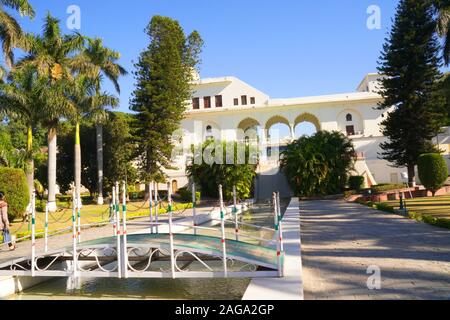
Further down, the Jal Mahal (Palace of Water) sits uniquely submerged in a pool, surrounded by fountains, creating a cool, fortified oasis that perfectly balances structural strength with aesthetic pleasure. The highest terrace features the Shish Mahal (Palace of Glass) and Hawa Mahal, while the second hosts the arched Rang Mahal (Painted Palace). The layout follows the classic Charbagh pattern, featuring a central water channel representing the rivers of paradise. Renamed Yadavindra Gardens to honor Maharaja Yadavindra Singh of Patiala, this 17th century's marvel was originally commissioned by Nawab Fidai Khan, Emperor Aurangzeb's foster brother. There is no prior clarification of prices while taking the order, which leaves customers surprised at the billing counter.I strongly recommend visitors to ask for the price list before ordering anything.
The hotel offers comfortable and luxurious rooms, with a view of the garden and the hills. The garden also has some options for accommodation, if you want to stay overnight or longer. Also, be mindful of the other visitors, and do not disturb or annoy them.
The garden also uses natural elements such as sunlight, shade, and breeze to create different effects and moods in different terraces. The design and layout of the garden take into account the climatic conditions, topography, and water availability of the region. The garden covers an area of 100 acres and is divided into seven terraces that descend from north to south. These legends reflect the diverse and rich cultural heritage of Pinjore Gardens. A third legend says that Nawab Fidai Khan built the garden for his beloved wife Noor Jahan, who was also the wife of Emperor Jahangir. One legend says that the garden was built by the Pandava brothers during their exile in the Mahabharata epic.
- Just a short drive from Chandigarh lies a place where time slows down, and nature takes center stage.
- The entire garden is lit up after sunset in such a way that the ambience of the garden changes completely.
- Though Babur held Samarkand briefly, its garden and the concept of charbagh (a quadrilateral garden layout based on the four gardens of Paradise mentioned in the Koran) made a profound impression on him.
As visitors enter through the big entrance, the first terrace created in Mughal Style will be the first thing they would see. The temple is created in Mughal style arranged out on seven terraces. In the 20th century, further enhancements were made by the last Maharaja of the Patiala dynasty, Maharaja Yadavindra Singh, in whose memory the garden was renamed Yadavindra Gardens. The garden, originally known as the Persian Gardens, was built in the 17th century during the reign of Mughal emperor Aurangzeb by Fidai Khan Koka, Aurangzeb’s foster brother. The main entrance leads to the highest terrace, where a palace stands as a testament to the fusion of Rajasthani and Mughal architectural elements.
By Road
This was audible in all corners of garden. The Yadavindra Garden is very good place to visit. Her book is regarded as the first serious study of Indian garden design. Corbusier could also have read Constance Villiers-Stuart’s account of the Pinjore garden (in The Gardens of the Great Mughals) – as Edwin Lutyens did when working on the design of New Delhi. Corbusier visited Pinjore’s Mughal Garden when working on the design of Chandigarh – and it is a pity he did not learn more from the experience. For a while I was transported back in time as I Yadavindra Gardens could visualise the dancers and singers entertaining the residents in the evenings.
Pinjore garden food dhaba
There is a central water channel that runs through the entire stretch broken up by dancing fountains at regular intervals. Situated in the city of Pinjore, in the district of Panchkula, these 17th-century gardens amalgamate the best of history, architecture, and nature. It lies dotted with palaces, lawns, a zoo, and even a Japanese garden. Pinjore Garden is an enchanting, Mughal-style garden, spread across seven levels. With cascading fountains, royal pavilions, and lush greenery, it’s a perfect spot for picnics, heritage walks, and evening strolls. The correct answer is Yadavindra gardens
Chandigarh City’s Leading Infotainment and Lifestyle Media. The garden has open lawns, a mini zoo, and a nursery, and is ideal for picnics and family outings. For pleasant weather and beautiful lighting, it’s best to visit early in the morning or during the evening. Pinjore Garden, officially known as Yadavindra Gardens, is located in Pinjore town, around 22 km from Chandigarh, on the Chandigarh–Shimla Highway (NH-5).
Also, if you have visited or plan to visit Yadvinder Garden, please share your experience and photos with us. Whether you are looking for a historical, cultural, or natural experience, you will find it in Yadvinder Garden. The garden is also easy to reach and explore, by road, rail, or air, and has some options for accommodation, if you want to stay longer.

The Pinjore Heritage train has been restored to take the passengers to the tourist spots and heritage sites situated in the garden. The temple is just 600 meters away from the Pinjore garden and is a must-visit site. The last seventh terrace has an open-air theatre which was used for performances by artists during ancient times. The floor plan of the garden is similar to the Charbagh pattern, which is a landmark style of Mughal architecture. The garden is a fine amalgamation of Islamic and Sikh architecture as it was built by Mughals and maintained and renovated by jat Sikh rulers of the Patiala Dynasty. One may plan a visit to the city in February as one will get to witness beautiful flowers blooming in the divine ambiance of the garden.

- Discover renowned gambling quests and secure your exciting payouts - 25/03/2026
- intelligente strategie per vincere ai giochi d’azzardo per tesaurizzare jackpot elettrizzanti e far crescere il tuo bankroll - 25/03/2026
- Odblokuj korzystne kursy: Twój przewodnik po dochodowych grach karcianych - 25/03/2026